In November 1983, a small company in Scotts Valley, California mailed a floppy disk and a slender manual to its first customers. The disk contained a Pascal compiler, an editor, and a linker. The price was $49.95. At the time, a professional Pascal compiler for an IBM PC — the kind a working programmer would buy from a university spinout or a mainstream software house — cost somewhere between $300 and $500, required multiple disks, and demanded that the developer step away from the editor, invoke the compiler as a separate program, wait several minutes, and return to inspect the results. What Borland International put in the envelope changed all three of those terms at once: the price, the wait, and the separation between writing and running.
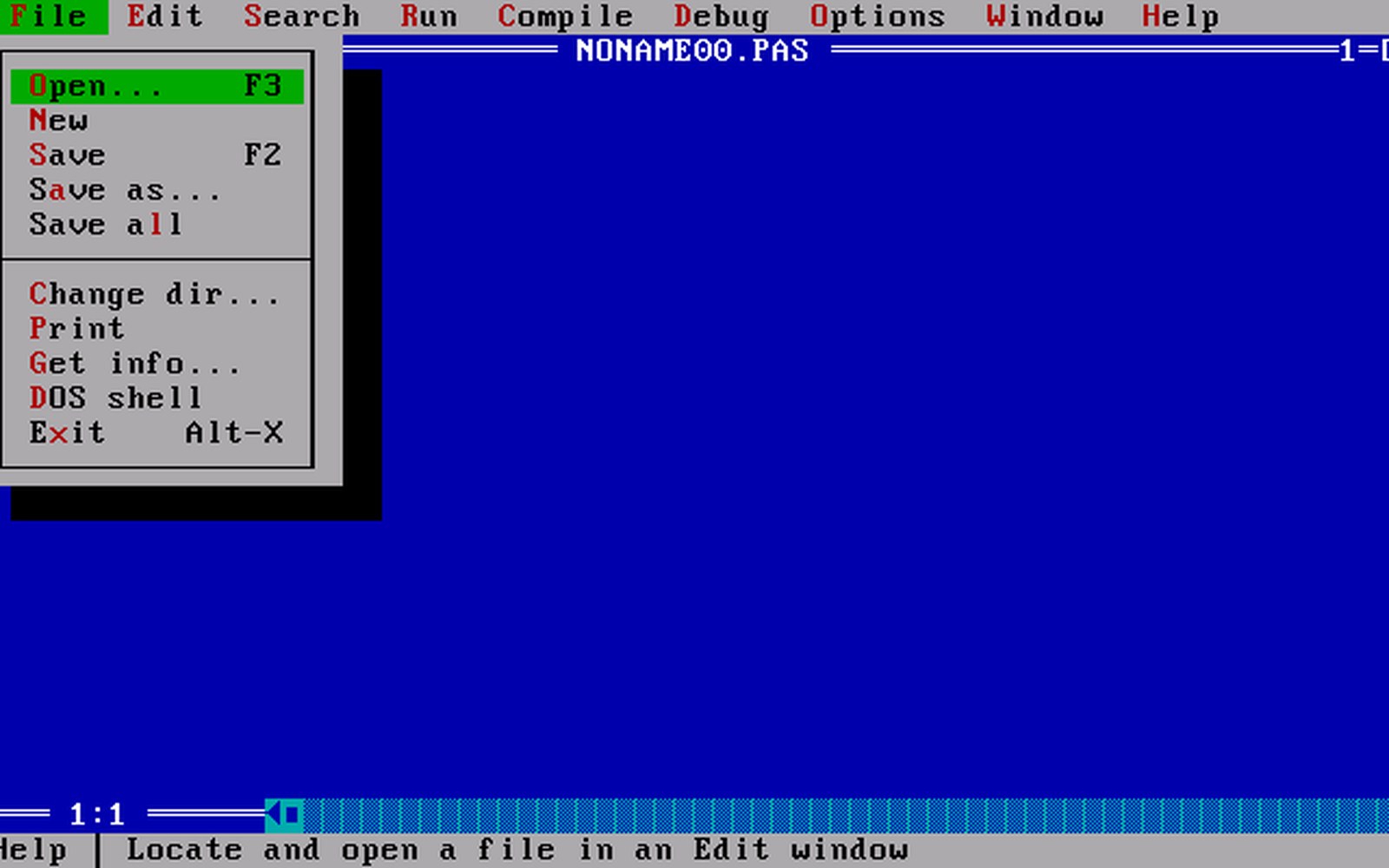
The product was Turbo Pascal, and its signature was the colour of its editor screen. The background was a deep, saturated blue — distinctive enough that it became the visual shorthand for a whole generation's first serious programming environment. The choice was cosmetic but not trivial. In a market where most development tools presented themselves in the unadorned monochrome of command-line utilities, the blue screen announced that something had been designed, that somebody had considered the experience of sitting inside the tool for hours at a stretch. Turbo Pascal's editor occupied the whole screen. The menu bar sat at the top. The status line sat at the bottom. Nothing was hidden in a separate window or invoked from a separate prompt. For a developer who had spent any time with the dominant workflow of the era — editor in one application, compiler in another, linker in a third — the single unified screen was a conceptual reorganisation, not merely a cosmetic one.
The engineering behind the price and the speed was Anders Hejlsberg's. He wrote Turbo Pascal's compiler in assembly language, tightly enough that the entire executable fit in memory simultaneously with the source code being edited. That residency was not an incidental optimisation; it was the structural precondition for the most important thing Turbo Pascal did. When the developer pressed Compile, the compiler was already in RAM. It did not load from disk, warm up, and begin processing. It began immediately, passing through the source in a single read — a single-pass compiler design that produced executable code without building an intermediate tree. On typical hardware of 1983, a program of a few hundred lines compiled in a handful of seconds. The subjective experience was that pressing a key produced a running program almost before the finger had left the keyboard.
That speed collapsed the edit-compile-run cycle from a multi-minute ritual into something close to continuous. A developer could write a procedure, compile it, watch it fail, fix the error — which Turbo Pascal would locate and highlight inside the same editor — and compile again, in the time it had previously taken to invoke the compiler once. This was not just comfort. It changed how programs were written: shorter iterations, quicker hypothesis-testing, less overhead in holding the mental model of a partially-finished program across a multi-minute wait. The tool reshaped the practice of the person using it.
Fifty Dollars, and What That Meant
Philippe Kahn, who co-founded Borland and drove the pricing decision, understood that the $49.95 figure was not merely a competitive undercut. It was a category reclassification. At $49.95, a Pascal compiler was no longer a capital purchase that a hobbyist weighed against a month's rent or a student budgeted across a semester. It was an impulse buy, or close to it — the kind of software that appeared on the same rack as games and wordprocessors in a retail store, that a reader of Byte magazine might order from a half-page advertisement without soliciting a purchase order. Kahn understood that the software market had a large latent population of programmers who had been priced out of serious tools. Turbo Pascal did not sell to that market; it created it as a market, by changing what the market was willing to imagine buying.
The advertisement that Borland ran in Byte in November 1983 offered the full package at $49.95 with a money-back guarantee — a tactic common in consumer software and virtually unheard of in developer tools, which were sold through resellers with support contracts attached. The pricing signal was reinforced by the packaging: one disk, one manual, one price. There were no tiered licences, no runtime royalties on compiled programs, no academic-versus-commercial distinctions. The compiler you used to learn Pascal was the compiler you used to ship a product, and there was one price for both.
What this did to the professional landscape took some time to become visible. In the short term, Turbo Pascal sold in numbers that stunned the development-tools market, moving hundreds of thousands of units in its first years and carrying Borland from a startup in Scotts Valley to a company large enough to challenge Lotus and Ashton-Tate for position in the PC software industry. In the medium term, the existence of a serious, fast, cheap Pascal compiler shifted Pascal's status from a teaching language — which its designer, Niklaus Wirth, had partly intended — toward a professional application development language on the PC. Programmers who had learned Pascal in university courses found that the tool they needed already existed, was already affordable, and was already good enough to build real software with.
The longer-term consequence was structural. Borland had demonstrated that developer tools could be priced as consumer software without becoming less serious as tools. Every subsequent pricing decision in the developer-tools market — the Turbo C launch in 1987, the growth of shareware compilers, eventually the emergence of open-source toolchains — was made in a landscape that Turbo Pascal had altered. The assumption that a professional tool necessarily cost hundreds of dollars had not merely been undercut; it had been falsified by a product that was, by any technical measure, the fastest Pascal compiler available on the PC at any price.
The blue screen itself persisted through multiple major revisions, through Turbo Pascal 2, 3, 4 and into the versions that added unit-based modular compilation and the Object Pascal extensions that would eventually become the foundation of Delphi's component model. Later interfaces adopted pull-down menus and mouse support. The colour was eventually negotiable. But the original configuration — blue background, instant compile, a price that said the tool was for everyone who could write code, not just everyone who could afford to — was the one that made the argument. Forty-nine dollars and ninety-five cents, on a single floppy disk, in the autumn of 1983.