The Medium, Not the Tool
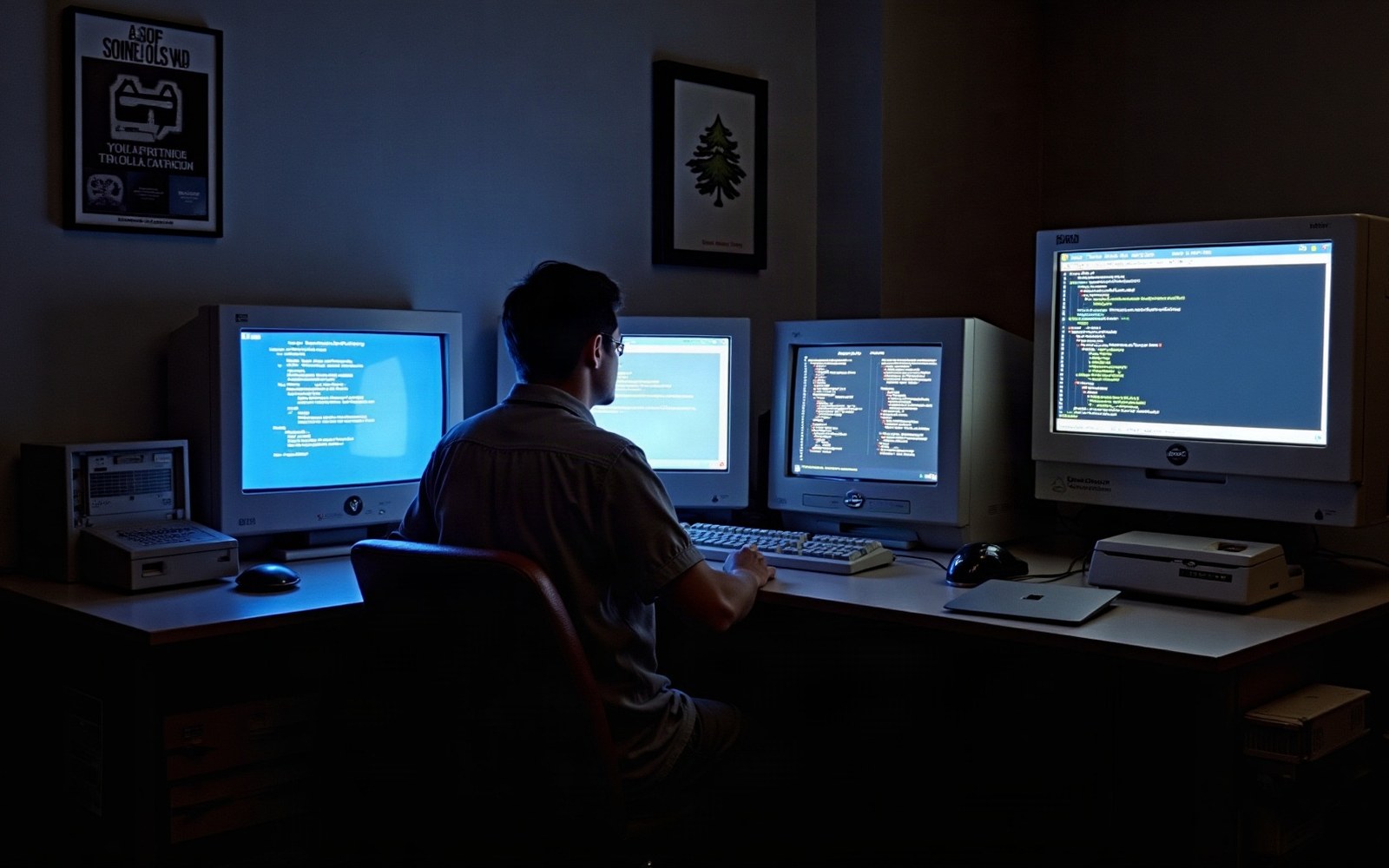
Alan Kay arrived at Xerox PARC in 1971 with a conviction that programming environments had been designed for the wrong purpose. Existing systems demanded that the programmer adapt — learning batch-submission protocols, waiting on card readers, reading output on fan-fold paper. Kay's Dynabook concept, sketched in a 1972 paper, proposed the opposite: a machine small enough and responsive enough to become a medium for thought, the way a notebook is a medium rather than an instrument. Smalltalk was the language conceived to inhabit that machine, but it could not have existed without the room around it — the integrated environment of editor, compiler, debugger and display that the PARC team built between 1972 and 1980.
The word "medium" is not a loose metaphor. Kay drew explicitly on the educational theories of Jerome Bruner and Seymour Papert, arguing that the representation chosen for an idea shapes the ideas that can be formed at all. A system in which a child could compose a program, immediately see it run, reach into the running image and change a value, then watch the consequence propagate — that system created a different cognitive relationship to programming than any tool that placed a compile-link-run wall between intent and result. The environment was the argument.
What Ingalls Actually Built
The argument needed an engineer willing to make it concrete. Dan Ingalls wrote the bytecode interpreter that executed Smalltalk at interactive speeds on the hardware available at PARC in the mid-1970s — hardware that offered, by the standards of the era, surprisingly little. He designed the object memory format, the method dispatch mechanism and much of the class library that gave the environment its vocabulary. He also wrote Smalltalk-80's BitBlt graphics primitive, the rectangle-copying operation that made overlapping windows possible on a bitmapped display without tearing.
Those overlapping windows were not decorative. They were the premise. When a programmer opened an inspector on a running object, examined its instance variables in one window, and edited a method in another while the system stayed live, the environment was demonstrating something that no sequential compile cycle could: that the program and the development environment were the same material. The image — Smalltalk's term for the complete serialised state of the system, objects and compiler and debugger together — could be saved and restored as a single file, making the development session itself a persistent artifact.
What the Room Contained
By the time Smalltalk-80 was distributed to a small set of external sites in 1980, the environment included what later generations would recognise as most of the checklist for a modern IDE. The class browser let a developer navigate the entire class hierarchy and edit method source in place. The debugger presented a live stack and allowed method edits to be compiled and resumed from the point of failure, without restarting the program — a capability that Visual Studio, Eclipse and IntelliJ IDEA would each rediscover decades later under the label hot-reload. The inspector showed object state continuously updated. Adele Goldberg, who led the documentation and educational work at PARC, ensured that this machinery was described and demonstrated in ways that reached audiences beyond the research community.
The influence distributed unevenly and slowly. Apple's Lisa and Macintosh teams visited PARC and carried away the window metaphor and the mouse interaction model, but not the live image. The compilers and editors that followed — Borland's Turbo Pascal in 1983, the early Visual Studio lineage, Delphi's component model — addressed integration and speed without recovering the idea that the running system and the editing environment should be a single continuous object. The separation between source file and execution that Smalltalk had refused to accept became the standard architecture of the industry.
Kay and Ingalls have both reflected publicly on that particular divergence, noting it without apparent bitterness: the industry chose a model it could ship on the hardware and business terms available to it. What the two men built at PARC between 1972 and 1980 remains the most complete statement of a different possible future — a room in which the program, the programmer and the environment were never separate things.